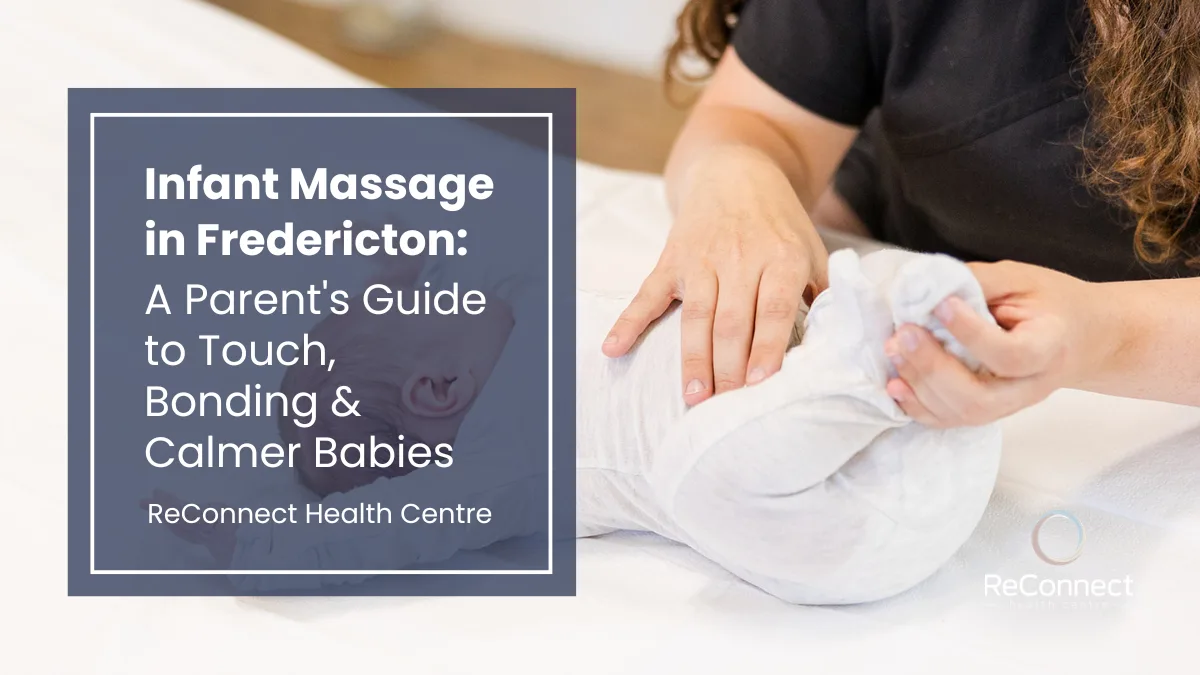
If you’ve ever instinctively rubbed your baby’s back to soothe a fuss, or stroked their tiny feet during a feed, you’ve already started practising infant massage. It’s one of the oldest forms of caregiving in the world — and one of the most quietly powerful tools you have as a new parent.
What turns that intuitive touch into therapeutic infant massage is technique, timing, and understanding your baby’s cues. That’s where structured infant massage instruction comes in. At ReConnect Health in Fredericton, infant massage is taught one-on-one by Courtney Mollins-Bidlake, RMT — a registered massage therapist with additional training in infant massage, craniosacral therapy, and over a decade of experience supporting families as a birth doula.
This guide walks through what infant massage is, what the research actually says it does, when to start, how a session in Fredericton works, and how Courtney’s craniosacral training adds another layer for babies dealing with tension, feeding challenges, or a difficult birth experience.
What Is Infant Massage?
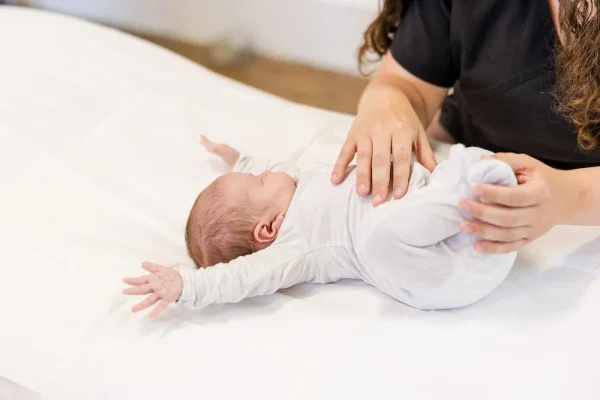
Infant massage is a gentle, structured form of therapeutic touch designed specifically for babies. Unlike adult massage, it isn’t about working out knots or releasing deep tissue — it’s about slow, repeated, predictable strokes that calm the nervous system, support digestion, and strengthen the connection between you and your baby.
In Courtney’s sessions, infant massage is a combined approach. She works hands-on with your baby — drawing on her RMT and craniosacral training to assess and respond to whatever she finds — and at the same time teaches you the strokes, the cues to watch for, and the timing, so you can continue supporting the work at home. That combination is what makes the difference: skilled hands in the clinic can address tension and patterns that are harder to reach on your own, while your at-home practice keeps the progress moving between visits and deepens the connection between you and your baby.
Sessions are gentle, slow-paced, and respectful of your baby’s state. If they fall asleep, fuss, or need a feed, we work with that. There’s no rigid sequence to push through.
Benefits of Infant Massage
Infant massage has been studied for decades, particularly in preterm and full-term newborn populations. Research has linked regular infant massage to a range of meaningful outcomes — some better-established than others. Here’s an honest summary of what tends to show up in the evidence and in our clinic experience:
- Stronger bonding and attachment. Touch is one of the primary languages of attachment in the first year. Predictable, attuned touch helps babies feel safe and helps parents read their baby’s cues more confidently — especially helpful if early bonding has felt harder than expected.
- Better sleep. Many families notice that babies who’ve had a massage as part of their evening routine settle faster and sleep longer stretches. The combination of nervous system regulation and the consistency of the routine itself both seem to play a role.
- Relief from colic, gas, and digestive discomfort. Specific belly-massage techniques can help move gas and stool through the digestive tract. For babies in the witching-hour stage, this is often the single most appreciated technique parents learn.
- Lower stress hormones in baby — and parent. Studies have shown reductions in cortisol levels for both baby and the person giving the massage. It’s a rare intervention that genuinely helps both sides of the relationship at the same time.
- Improved weight gain in preterm infants. This is one of the most well-established effects in the research, with massage supporting growth and neurological development in babies born prematurely.
- Eased tension from birth. Babies who’ve had long labours, instrumental deliveries, or C-section births sometimes hold tension in the head, neck, or jaw. Gentle massage can help, and this is where Courtney often combines infant massage instruction with craniosacral therapy.
- Confidence for new parents. Maybe the most underrated benefit. Knowing you have a tool that calms your baby — and that you can use it — changes how the long evenings feel.
When Can You Start Infant Massage?
You can start as early as the first few weeks of life. Many parents book their first session somewhere between 2 and 6 weeks postpartum, once feeding has settled into a rhythm and the umbilical area has healed. There’s no upper limit either — older babies and toddlers benefit too, though the strokes and pacing adapt as they grow.
If your baby is in a NICU or has any medical complexity, please check with your medical team before booking.
What to Expect at an Infant Massage Session in Fredericton
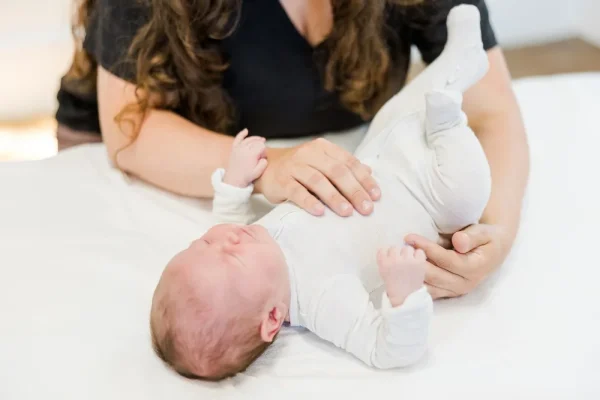
Sessions are held at our Fredericton clinic on Regent Street, in a private treatment room set up for parent and baby. Here’s how a typical first appointment unfolds:
- Brief intake. Courtney will ask about your baby’s birth, feeding, sleep, digestion, and anything specific you’d like to focus on — colic, sleep, recovery from a difficult birth, bonding after a hard postpartum.
- Setting up. Baby goes onto a soft padded surface (clothed, diapered, or undressed depending on age and comfort). A warm room, dim-ish lighting, and a calm pace are the foundation.
- Hands-on assessment and treatment. Courtney begins by working with your baby directly — drawing on her infant massage and craniosacral training to assess posture, tension patterns, and how your baby is holding their body, and gently addressing what she finds. This is treatment, not demonstration.
- Teaching as she works. As she moves through the sequence, Courtney walks you through what she’s doing and why, then guides you into doing the strokes yourself so you can practise with her right there to coach you. The full sequence covers legs, feet, belly, chest, arms, face, and back — but the order and pacing flex to your baby’s cues.
- Reading your baby. A big part of the session is learning to recognize engagement cues (eye contact, soft body, focused gaze) versus disengagement cues (turning away, hiccups, fussing). This is the skill that translates infant massage from a routine into a relationship.
- Take-home plan. You leave with a simple at-home routine you can do that evening to keep the work moving between sessions — not a list of homework, just a confident starting point.
Sessions are typically 45 to 60 minutes. Many families book a series of 2–3 sessions to build the routine and check in as baby grows.
The Craniosacral Connection: When Massage Alone Isn’t Quite Enough
Courtney is also certified in craniosacral therapy (CST), which is a complementary skill set when working with infants. Craniosacral therapy is an extremely gentle hands-on therapy — the pressure used is often described as “the weight of a nickel” — that focuses on the connective tissues, skull, spine, and sacrum.
For infants, CST is most commonly used for:
- Tension after a long, fast, or instrumental birth (forceps, vacuum, C-section)
- Latching difficulties or strong feeding preference to one side
- Plagiocephaly (flat-head positional tension) and torticollis-related tension
- Babies who seem chronically tense, arching, or hard to settle
- Reflux and digestive discomfort linked to body tension
The research base for CST in infants is smaller and more mixed than the research on infant massage, and we’re upfront about that. What we can say is that it’s gentle, non-invasive, and many parents report meaningful change after a few sessions. Courtney will tell you honestly if she thinks CST is likely to help your baby — and if she thinks something else (lactation support, paediatric assessment, physiotherapy referral) might be a better fit, she’ll say that too.
When Infant Massage Isn’t Appropriate
Infant massage is safe for the vast majority of healthy babies. We’ll adjust or postpone the massage if:
- Your baby has a fever or is acutely unwell
- Recent vaccinations are causing tenderness (wait 24–48 hours)
- There’s a skin condition or rash in the area
- Your baby has recently been fed (we wait about 45 minutes before belly work)
- Your baby is sending strong “not now” cues — which we always honour
If your baby has any medical complexity — congenital conditions, a history of NICU care, post-surgical recovery — please mention it at booking so Courtney can plan the session appropriately.
Meet Courtney Mollins-Bidlake, RMT
Courtney is a registered massage therapist with a depth of perinatal experience that’s rare to find in one practitioner. Alongside her RMT registration, she holds certifications in infant massage and craniosacral therapy, and she has been working as a birth doula for more than a decade.
What that means in practice: she understands babies not just from the outside as a clinician, but from the inside as someone who has been in countless birth rooms, postpartum suites, and living rooms during the first sleepless weeks. She can recognize a tension pattern that traces back to a long second stage of labour. She can spot a baby who’s having a hard time turning to one side for feeds. She can hold space for a parent who didn’t get the birth they hoped for and is trying to find their footing.
Courtney sees clients at our Fredericton clinic and is registered with the College of Massage Therapists of New Brunswick. Her sessions are eligible for direct billing through most extended health plans that cover RMT services.
Frequently Asked Questions About Infant Massage in Fredericton
What age can I start infant massage?
As early as the first few weeks of life, typically once feeding has settled and the umbilical area has healed (usually around 2–6 weeks). Older babies and toddlers benefit too — the strokes and pacing simply adapt.
How is infant massage different from just rubbing my baby?
The instinctive touch you already do is wonderful and you should keep doing it. Structured infant massage adds specific strokes (for example, “I Love U” for digestion), a predictable sequence your baby’s nervous system can anticipate, and an understanding of engagement cues so you can read what your baby actually needs in the moment.
Will infant massage help with colic?
Many parents report meaningful improvement, especially with specific belly-massage techniques that help move gas and stool. The research on colic is mixed — colic is complex and often multifactorial — but infant massage is one of the few interventions that’s safe, low-cost, and worth trying. If massage alone isn’t enough, Courtney can help assess whether craniosacral therapy, lactation support, or a paediatric referral might add value.
How long is a session with Courtney?
First sessions are typically 60 minutes; follow-ups are 45–60 minutes depending on what you want to cover. Many families book a series of 2–3 sessions to build the routine confidently.
Do I need to bring anything?
Just your baby. We provide the soft padded surface, oil (we use a gentle, fragrance-free, food-grade option safe for infants), and everything else needed. Wear something comfortable that you don’t mind a little oil on. Bring a feeding if it’s near a feed time.
Can I just learn this from YouTube?
You can pick up the basics from videos, and that’s better than nothing. What YouTube can’t do is watch your specific baby, adjust the strokes to their body, help you read their unique cues, or troubleshoot when your baby seems uncomfortable. A one-on-one session in Fredericton turns generic technique into something tailored to your baby.
What’s the difference between infant massage and craniosacral therapy?
Infant massage is a parent-led practice using slow rhythmic strokes — you learn it and use it at home. Craniosacral therapy is a hands-on treatment performed by a certified practitioner, using extremely gentle pressure to release tension in the connective tissues, skull, and spine. They work well together. Courtney is trained in both and will help you decide what your baby needs.
Is infant massage covered by insurance in New Brunswick?
Yes, in most cases. Because Courtney is a registered massage therapist, sessions are typically eligible under extended health plans that cover RMT services. Coverage varies by plan — check with your insurer if you’re planning to claim. We offer direct billing to most major insurers in Fredericton.
Should both parents come to the session?
Absolutely, if it works for your family. Partners, grandparents, and other primary caregivers are all welcome and often benefit just as much from learning the technique.
Book an Infant Massage Session in Fredericton
Whether you’re a new parent looking for one more tool in the toolkit, or you’re working through a specific challenge like colic, sleep, or post-birth tension, infant massage can help. Book online with Courtney at our Fredericton clinic on Regent Street, or send us a message if you’d like to talk through whether infant massage, craniosacral therapy, or a combination is the right starting point for your baby.
If you’re still pregnant and reading ahead, take a look at our prenatal massage guide — many of Courtney’s infant massage clients come to her during pregnancy first and continue through postpartum and into the early months with baby.
Touch is one of the first conversations you and your baby will ever have. We’d love to help you start it well.